How long does a fall take? A physics question with a Python answer
Drop a ball from a height, and you can calculate when it lands. Write the formula in a few lines of Python, change the height, and discover why a heavy ball and a light ball land together.

17 November 2026 · 1 min read · All posts by StemPy Lab
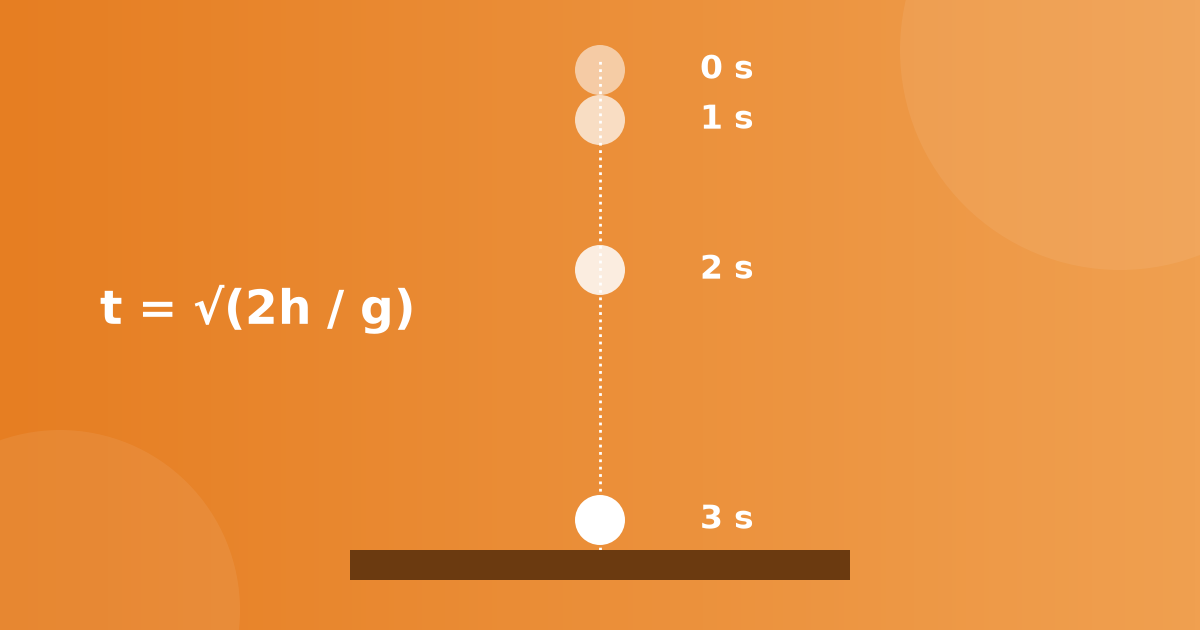
You drop a ball from the top of a building. Before it reaches the ground, how many seconds pass?
Physics gives a neat answer. For an object that starts from rest, and falls a height with the acceleration :
Here near the surface of the Earth. We ignore the air.
Let the computer do it
A fall of metres takes about seconds.
Predict, then change
The surprise: the mass is not there
Look at the formula again. Is there a mass anywhere? No. A heavy ball and a light ball, dropped together, land together, if the air does not matter. A feather falls slowly only because of the air. On the Moon, where there is almost no air, a hammer and a feather land at the same time. The astronauts really did this.
A table of falls
The right column grows slowly. Falling from metres takes only about seconds.
Why use Python here?
Because you can change the height and see the answer move. Doing that ten times teaches you more than reading the formula once.
Where to go next
The chapters Motion in a Straight Line and Work, Energy and Power in Physics, High School (11–12), use this kind of reasoning. Most lessons have a Python box or a simulation like this one, so you can always ask: what if the number were different?
Discussion (0)
Log in to join the discussion.
Loading…
AP Physics 1: a study plan with two Section I practice exams
The eight AP Physics 1 units, which topics the StemPy Lab courses already cover, a pace for 40 questions in 80 minutes, and a two-week and a four-week plan built around two free Section I practice exams.
ApAp physics 1Practice exam